
The Great Dental Reckoning: Why the UK's biggest healthcare market is rewriting its own rules
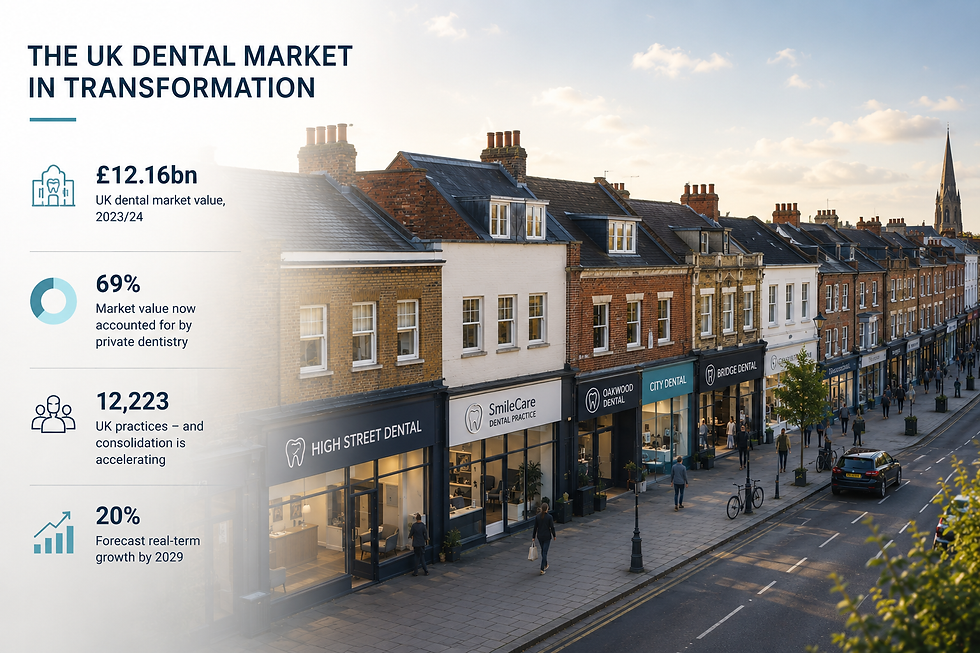
The UK dental market is worth £12.16 billion and growing fast. The NHS model that underpinned it for decades is buckling. Private equity is reshaping the landscape at pace. Here's what's happening — and why it matters.
£12.16bn - UK dental market value, 2023/24
69% - Market value now accounted for by private dentistry
12,223 - UK practices — and consolidation is accelerating
20% - Forecast real-term growth by 2029
A market in transition, not in trouble
The UK dental sector isn't in crisis. It's in transformation. A market in crisis contracts and loses confidence. A market in transformation sees capital flood in, ownership structures shift, and inefficient models get replaced. What we're witnessing is the latter — and the groups that recognise that early are the ones pulling ahead.
NHS vs private: the honest picture
NHS dentistry now accounts for just 31% of market value. That shift didn't happen because dentists stopped caring about access. It happened because the system made it structurally difficult to run a viable NHS practice — fixed UDA rates that haven't kept pace with costs, a recruitment crisis, and a reform timetable measured in decades, not years.
NHS dentistry
UDA contract pressure Fixed rates that haven't kept pace with costs or clinical complexity
Staffing crisis Shortages limiting capacity; some regions now "dental deserts"
Reform uncertainty 10-year NHS vision published July 2025 — ambition clear, delivery timescales less so.
Private dentistry
Stronger margins Associate-led models averaging 23.7% EBITDA — and rising
Resilient demand Cost-of-living pressures haven't dented necessary treatment volumes
Investor appetite Corporate buyers consistently targeting private and mixed-model practices
"Private-pay dentistry now accounts for the highest proportion of market value since tracking began. That's not a trend. That's a structural shift."
The PE consolidation wave — and where it's heading
Private equity identified UK dentistry early: predictable demand, fragmented ownership, significant margin improvement potential. The first consolidation wave was fast and acquisitive. The second — the one we're in now — is smarter. After a period of portfolio refinement through 2023–24, corporate buyers returned to market in 2025 with a different mindset: quality over scale, stable clinical teams, and real growth headroom.
mydentist
511 practices. The UK's largest dental group — navigating a complex NHS-to-private transition at real scale.
PortmanDentex
376 practices. Born from the Portman and Dentex merger — a textbook PE platform-and-bolt-on story.
Rodericks / Dental Partners
One of the most significant recent consolidation events — NHS heritage, growing private capability, serious scale.
What consolidation actually means for patients and stakeholders
The lazy narrative frames consolidation as a race to the bottom. The reality is more nuanced. Scale brings procurement power, investment in clinical technology, and structured career pathways that independent practices can't match. And PE investors understand something important: quality is the multiple. A group that lets clinical standards slip will see it reflected at exit. In healthcare, that commercial reality is a powerful quality lever.
"The groups that exit well aren't the ones that acquired the most. They're the ones that built the most coherent operating model across their estate."
The operational challenge hiding in plain sight
Here's the tension at the heart of dental consolidation: the deal thesis is straightforward. Execution is not. Buying practices is the easy part. Making 50, 100, or 500 practices feel and function like a coherent group — consistent brand standards, clinical protocols, patient experience — is where the hard work lives. The groups winning operationally are the ones investing in the infrastructure that makes consistency possible at scale. That's the gap that determines whether a dental group's growth story delivers lasting enterprise value, or just a larger problem for the next owner.
The UK dental market is one of the most structurally interesting sectors in British healthcare right now. Large, growing, and mid-transformation. The groups that get the operational infrastructure right will be the ones worth watching — and the ones best placed to deliver on the promise that brought investors in the first place.